


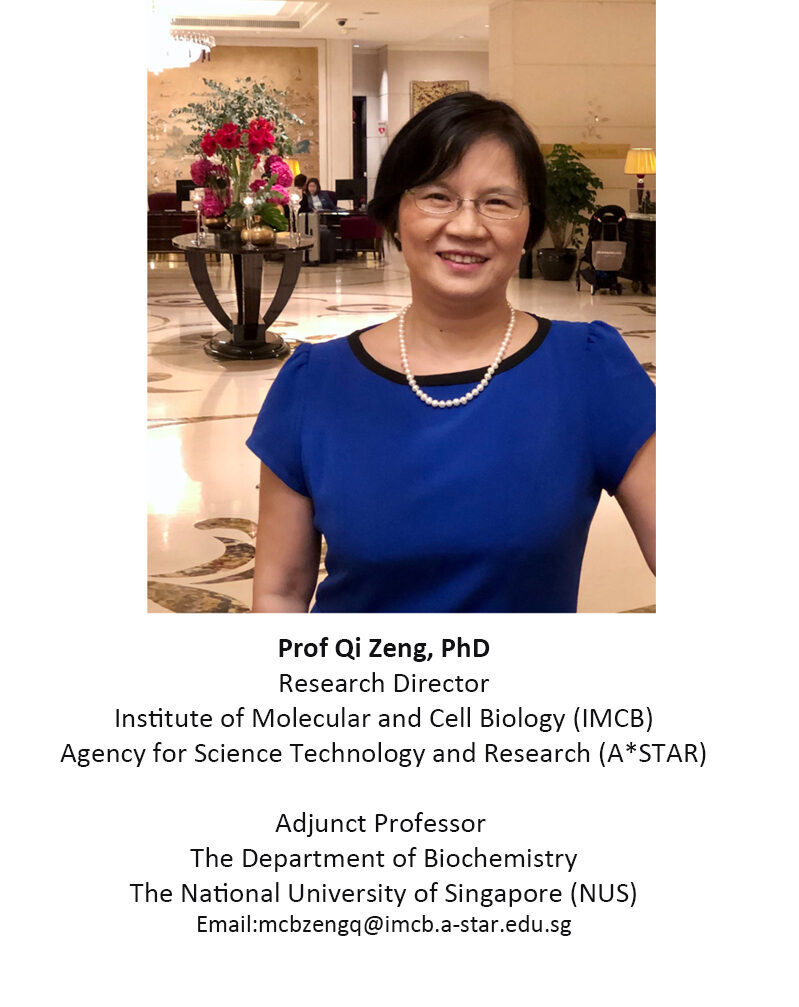
Prof Qi Zeng, PhD
Founder
Chief Scientific Officer
Professor Qi Zeng was trained as a molecular and cell biologist at the Roswell Park Comprehensive Cancer Center (USA) and the National University of Singapore. A pioneer in using animal models to study human disease, she engineered Asia’s first transgenic rat for diabetes research (1991)—a milestone featured in Fortune Magazine. In 1998, Prof. Zeng identified the PRL-3 gene (PTP4A3). Its critical role in cancer progression and metastasis was later validated by Professor Vogelstein’s team at Johns Hopkins University in 2001.
While PRL-3 is a recognized pan-cancer oncoprotein overexpressed in most human tumors and nearly undetectable in healthy tissue, its intracellular location traditionally labeled it “undruggable” by antibodies. Prof. Zeng challenged this convention, pioneering the concept of targeting intracellular oncoproteins with antibody therapy and vaccinations. To translate these findings, her team developed PRL3-zumab, a first-in-class humanized antibody. After demonstrating an excellent drug safety profile in Phase 1 trials at NUH Singapore, PRL3-zumab has received regulatory approval from the FDA, HSA, NMPA, and NPRA for Phase 2 clinical trials. Multi-national Phase II basket trials have now been successfully completed, demonstrating a robust safety profile and clear therapeutic efficacy across multiple cancer indications.
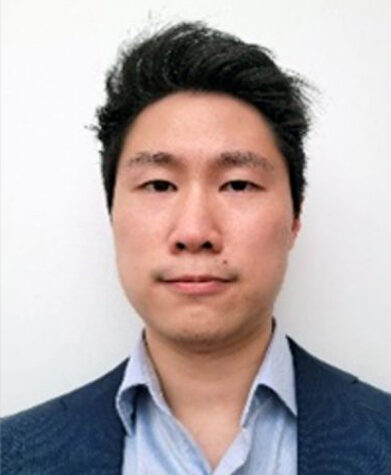
Mr Charles Tang
Chief Executive Officer
Mr Charles Tang is the CEO of IISG. He charts the growth of IISG and is actively involved in fundraising efforts for the company. Concurrently, he is the Founder and CEO of AP Technologies which focuses on innovating catheter and tubing manufacturing solutions to medical device companies. He has been in the management team at AP Technologies for ~10 years. His management expertise and business acumen have led him to clinch the highly coveted Emerging Enterprise Award in 2022. He received his B.Sc in Finance and Operations Management from Boston University (Questrom School of Business).

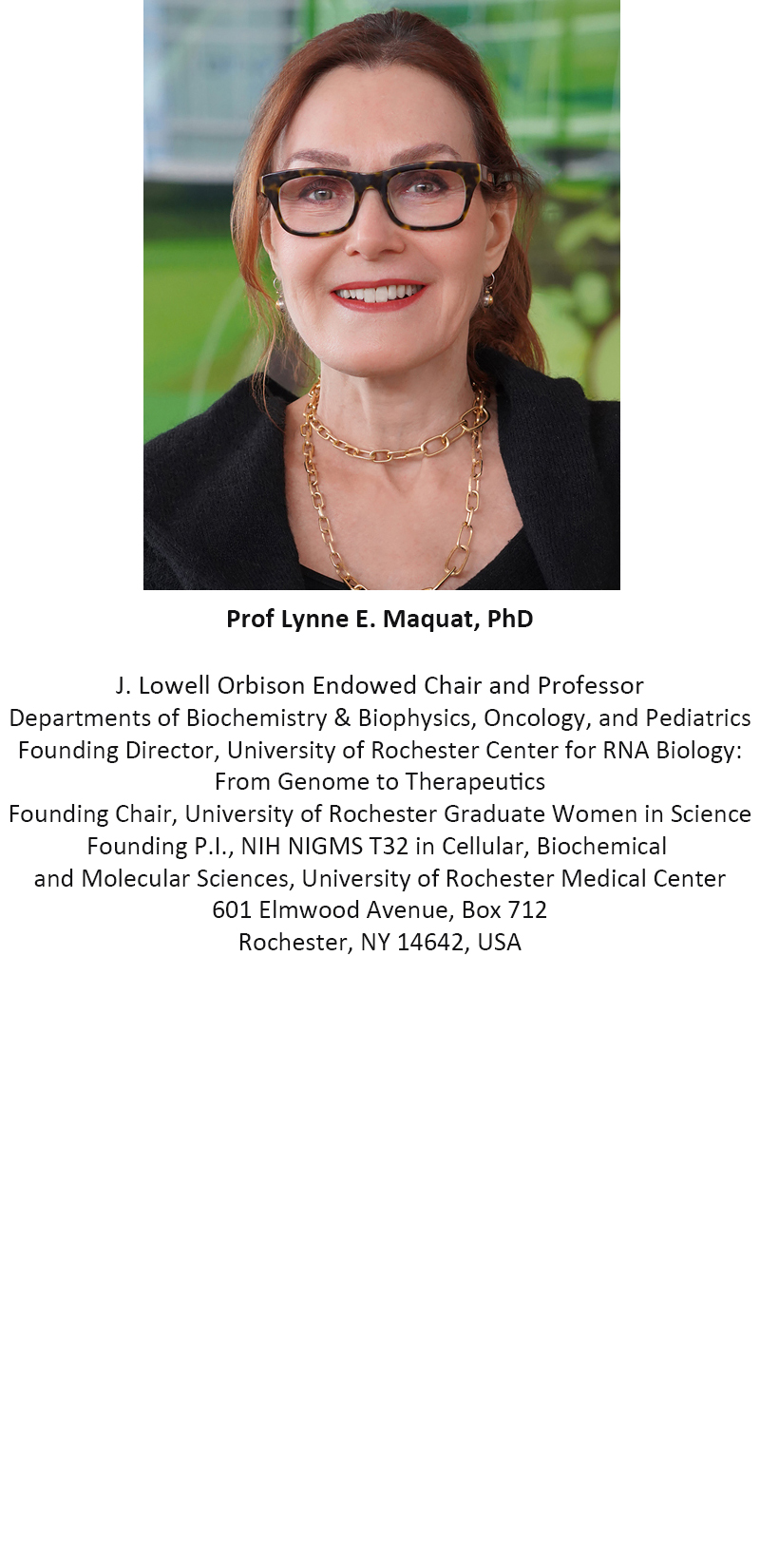
Prof Lynne E. Maquat, PhD
SAB Member
Lynne E. Maquat, PhD is the J. Lowell Orbison Endowed Chair and Professor of Biochemistry & Biophysics who holds concomitant appointments in Pediatrics and in Oncology, Founding Director of the Center for RNA Biology, and Founding Chair of Graduate Women in Science at the University of Rochester, Rochester, NY, USA. After obtaining her PhD in Biochemistry from the University of Wisconsin-Madison and undertaking post-doctoral work at the McArdle Laboratory for Cancer Research, she joined Roswell Park Cancer Institute before moving to the University of Rochester Medical Center.
Dr. Maquat’s research focuses on the molecular basis of human diseases, with particular interest in mechanisms of mRNA decay. Maquat discovered nonsense-mediated mRNA decay (NMD) in human diseases in 1981 and, subsequently, the exon-junction complex (EJC) and how the EJC marks mRNAs for a quality-control “pioneer” round of protein synthesis. She also discovered Staufen-mediated mRNA decay, which mechanistically competes with NMD and, by so doing, new roles for short interspersed elements and long non-coding RNAs. Additionally, she has defined a new mechanism by which microRNAs are degraded, thereby regulating mRNAs so as to promote the cell cycle. One of her current interests focuses on the development of therapeutics for diseases that she has shown manifest hyperactivated NMD, including the most common single gene cause of intellectual disability and autism, Fragile X Syndrome. Maquat is an elected Fellow of the American Association for the Advancement of Science (2006); an elected Member of the American Academy of Arts & Sciences (2006), the National Academy of Sciences (2011), and the National Academy of Medicine (2017); and a Batsheva de Rothschild Fellow of the Israel Academy of Sciences & Humanities (2012-3).
She was recently elected to the Council of Scientific Advisors for the International Centre for Genetic Engineering and Biotechnology (ICGEB), an initiate of the United Nations Industrial Development Organization (2022). She received the William C. Rose Award from the American Society for Biochemistry & Molecular Biology (2014), a Canada Gairdner International Award (2015), the international RNA Society Lifetime Achievement Award in Service (2010) and in Science (2017), the FASEB Excellence in Science Award (2018), the Vanderbilt Prize in Biomedical Science (2017), the Wiley Prize in Biomedical Sciences from Rockefeller University (2018), the International Union of Biochemistry and Molecular Biology Medal (2019), the Wolf Prize in Medicine from Isreal (2021), the Warren Alpert Foundation Prize from Harvard Medical School (2021), and the Gruber Genetics Prize from the Gruber Foundation and Yale University (2023). Maquat is well-known for her national and international efforts to promote women in science.
Our Journey
‘英创’是个临床二期的新加坡生物技术公司,研发人源化的抗体药物为靶向免疫治疗来抑制多种常见的高表达PRL3的肿瘤类型。
‘英创’的核心概念开始于1998年。公司的创办人,曾琦教授和她的团队在分子和细胞生物学研究院(IMCB)(新加坡科技研究局(A*STAR))发现了PRL3 (Zeng et al., BBRC, 1998) 。
在2008年, 曾教授首次提出一个全新的概念,采用抗体药物(而不是小分子的化学药物)来治疗高表达细胞内肿瘤蛋白的肿瘤。秉持着这个创新性的概念,曾教授的团队研发了PRL3-zumab用来治疗多种高表达PRL3的肿瘤类型。

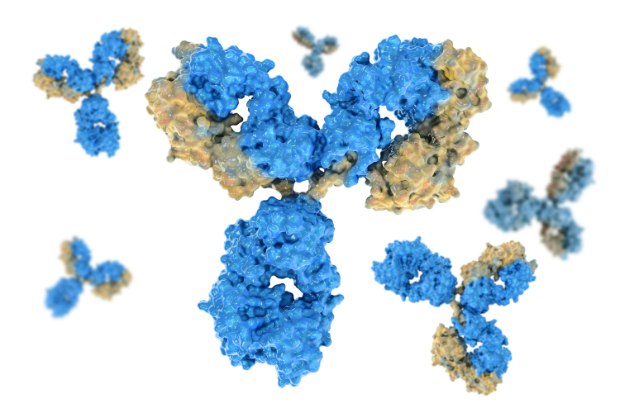
PRL3-zumab 提供免疫治疗领域一个全新的手段,不仅能治疗肿瘤,也能用于与PRL3高表达的疾病。‘英创’开创了新的概念,有着一系列的药物及疫苗来治疗现代医学无法医治的疾病,以此希望能带给全世界的病人新希望。
在2015年12月,曾教授设立了‘英创’私人有限公司,从新加坡科技研究局(A*STAR)分出成为独立的生物技术公司。曾教授是一位尽责的科学家,有着多年及扎实的动物模型和肿瘤研究的经验。PRL3-zumab 是曾教授及团队20年余的科研成果,从基础体外实验、模拟人类癌症的动物模型到2017年新加坡临床一期的艰辛科研生涯。
从2017至2018年,PRL3-zumab完成了国立大学医院(NUHS)的临床IA及IB期的试验。临床试验显示PRL3-zumab的早期疗效及安全性。
在2019年,PRL3-zumab 获得新加坡卫生科学局(HSA)的批准后开始在新加坡国家肿瘤中心(NCCS)进行胃癌及肝癌(晚期实质性肿瘤)的二期临床试验。
在2020年,PRL3-zumab 获得美国食品药品管理局(FDA)和中国国家药品监督管理局(NMPA)用于实质性肿瘤治疗的临床二期试验的批准。这是‘英创’和美国及中国多家医院的合作项目。